1. Introduction: The Death of the Click and the Rise of the Citation
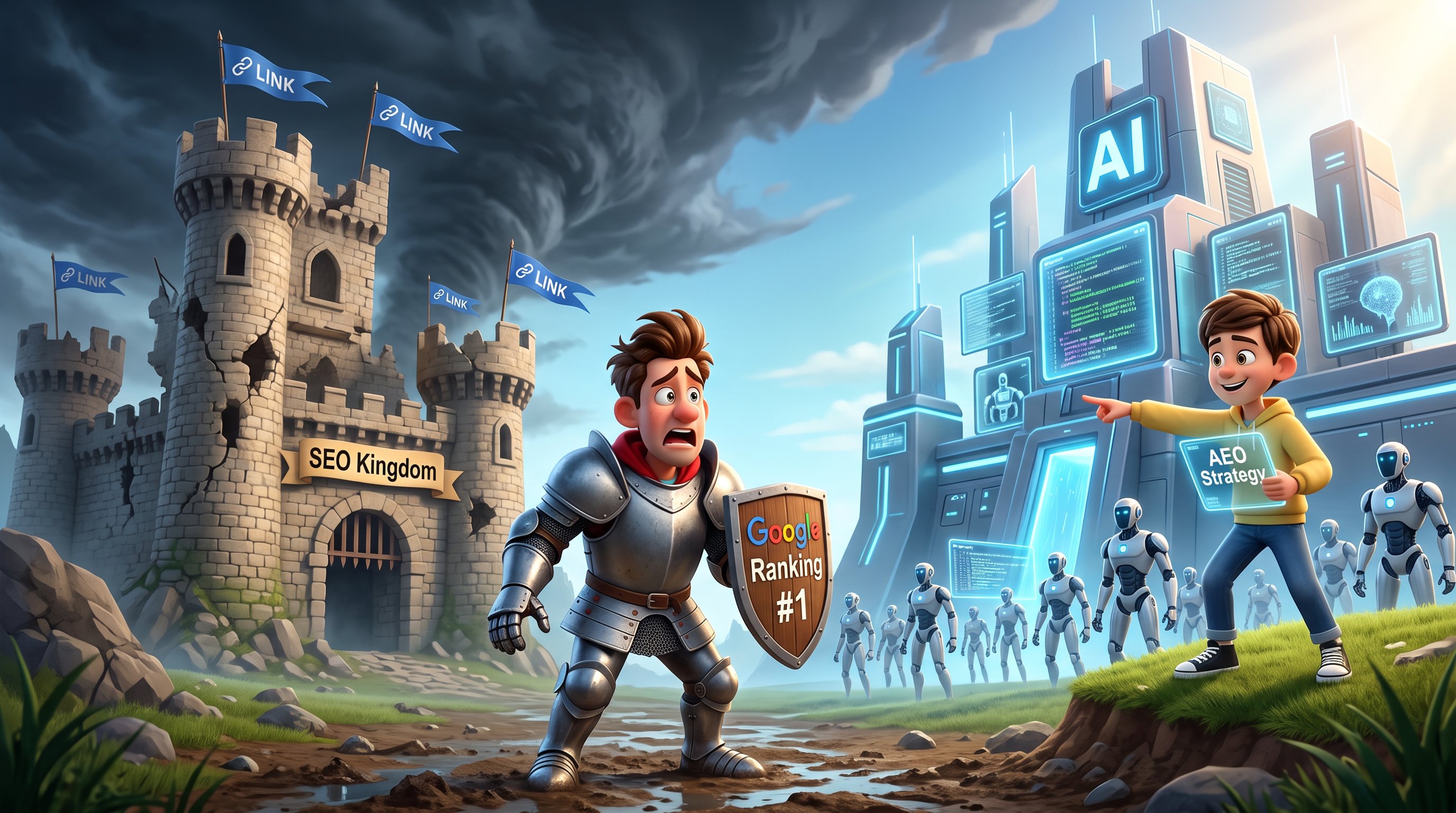
The traditional search landscape is undergoing an existential transition. With the rollout of Google AI Overviews and the rise of Perplexity, we have entered a “zero-click” reality. In this new paradigm, AI engines synthesize answers directly, often bypassing the need for a user to ever visit your website. For modern brands, this isn’t just a shift in tactics; it’s a shift from Search Engine Optimization (SEO) to Generative Engine Optimization (GEO).
Visibility in the AI era is no longer about fighting for a spot in a list of blue links. It is about becoming a “trusted data source” for Large Language Models (LLMs). Your mission is no longer to rank, but to be the definitive citation that the machine trusts to represent the truth.
2. The 40% Visibility Boost: The “Leveling Effect” of Expert Content
The Princeton GEO Study (KDD 2024) provides the first academic blueprint for AI visibility. By testing 10,000 queries, researchers found that specific “Expert Upgrades” can boost your citation probability by up to 40%.
Perhaps most surprising is the “Leveling Effect”: while top-ranked sites saw a decrease in visibility when citations were added, lower-ranked sites (those at position 5 or below) saw a massive 115.1% visibility improvement by citing authoritative sources. This creates a massive strategic window for challenger brands to leapfrog established incumbents.
Top-Performing AI Content Tactics:
- Expert Quotes (+41%): Attributing insights to named authorities acts as a credibility proxy for LLMs.
- Statistics and Data (+30–40%): Replacing qualitative fluff with quantitative data signals “factual density.”
- Inline Citations (+30%): Linking to authoritative third-party sources signals that your site is a node in a credible information network.
- Domain-Specific Terminology (+21%): Using technical language appropriate for your niche establishes topical authority.
“Combining strategies outperforms any single tactic by over 5.5%. The highest-performing combination was fluency optimization (readability) plus the addition of granular statistics.”
The Warning: Traditional “keyword stuffing” is now a liability. The study recorded a -9% visibility penalty for content that uses unnatural repetition, as AI models are trained to downgrade low-perplexity, robotic text.
3. The JavaScript Blind Spot: Why Your Modern App Might Be Invisible
As a Technical SEO Lead, I see this “catastrophic failure” constantly: developers relying on Client-Side Rendering (CSR). While CSR is popular for dynamic web apps, it is a visibility killer for AI.
The technical reality is that no major AI crawler except Googlebot renders JavaScript reliably. Analysis shows that 46% of ChatGPT bot visits begin in “reading mode”—a plain HTML version with no images, CSS, or scripts. If your content requires a browser to execute JS before it appears, you are effectively invisible to GPTBot, PerplexityBot, and ClaudeBot.
| Rendering Strategy | JS Execution Support | LLM Crawlability | Recommendation |
|---|---|---|---|
| SSR / SSG | Not Required | Excellent | Baseline for AI visibility. Content is in the raw HTML. |
| ISR (Incremental) | Not Required | Excellent | Best for large sites needing freshness (e.g., Next.js). |
| CSR (React/Vue SPA) | Required | Catastrophic | Invisible to GPTBot and PerplexityBot. Avoid for content. |
The Strategic Baseline: If you are rebuilding for AI, adopt Astro (which ships zero JavaScript by default) or Next.js with robust Server-Side Rendering. Content must be “grounded” in the initial HTML response.
4. Mentions > Backlinks: The New Authority Hierarchy
For decades, backlinks were the currency of the web. In the AI era, that currency has devalued. Research reveals that brand mentions (linked or unlinked) correlate 3x more strongly with AI visibility than traditional backlinks (0.664 vs. 0.218).
AI engines use “Consensus” and “Entity Verification” mechanisms. They cross-check facts across the web to build a trust graph. If your brand is mentioned frequently on “trusted domains,” the AI treats your information as verified truth.
“Reddit is the universal citation leader. It accounts for 46.7% of Perplexity’s top-10 citations and 21% of Google AI Overviews’ top sources.”
To win the “Consensus” war, your off-site presence on Reddit, Wikipedia, and G2 is now a primary driver of your on-site visibility.
5. The “Answer-First” Blueprint: Structuring for Machine Extraction
AI engines utilize Retrieval-Augmented Generation (RAG), meaning they “chunk” your pages into modular units. If your expertise is buried in a 3,000-word block of prose, it won’t be retrieved. You must shift to an “Answer-First” architecture.
The “Mini-Title” and “Answer Nugget” Rule
Transform generic headers into specific prompts.
- Before: “Product Specifications”
- After (Mini-Title): “What is the noise level of the XYZ Dishwasher?”
Follow this with an “Answer Nugget”: a 40–60 word summary that provides a self-contained answer. These nuggets are the primary units of extraction for AI summaries.
Structure for the Machine
- Listicles Dominate: Listicles account for 32% of all AI citations—triple the rate of standard blog posts. If your data can be a list, make it a list.
- Deep Nesting: 82.5% of AI citations link to deeply nested pages, not homepages. Your internal linking must point toward “nested expertise” (how-to guides, specific comparisons) rather than the root domain.
- The “DIY vs. Paid” Strategy: AI often presents a choice between doing it yourself and buying a service. Structure your content to say: “DIY the easy stuff (link to guide), but let us handle the complex automation for you.”
A Nuanced Truth on Schema
While I recommend prioritizing FAQPage, HowTo, Person, and Organization schema, do not rely on them alone. LLMs tokenize JSON-LD, making it indistinguishable from ordinary words during content processing. In many cases, models ignore schema entirely in favor of visible text. Use schema to signal traditional search engines, but use visible “Answer Nuggets” to feed the LLM.
6. The “llms.txt” Reality Check: Separating Theory from Fact
There is significant hype around the llms.txt standard—a proposed Markdown file at the site root to guide AI agents. While elegant in theory, there is currently no data or evidence that these files boost AI visibility or citations in general search.
While useful for coding assistants (like Cursor) to parse documentation, major engines like OpenAI and Google have not officially announced support for this as a ranking factor. Prioritize Server-Side Rendering and content quality over “emerging” standards that lack empirical proof.
7. Conclusion: From Destination to Data Source
We are entering the “Citation Economy.” Success is no longer measured by the click, but by the frequency and accuracy with which your brand is cited.
The final multiplier for this economy is Freshness. Content updated within the last 30 days earns 3.2x more citations than older material. In the AI era, expertise is a perishable good. LLMs favor the most recent corroboration of facts.
As you audit your digital strategy, you must ask one provocative question: In a world where the AI provides the answer without the user ever clicking your link, is your brand’s expertise documented well enough for the machine to trust it?
How Kaistone can help you win the AI Search War
Navigating the shift from SEO to GEO requires more than just guesswork. At Kaistone, our AI Audit Engine measures exactly how your brand performs across these new ranking signals—from AI readability and answer-ready content to trust and authority metrics.
Are you ready to stop fighting for blue links and start winning AI citations? Contact us today to book your free AI Audit and get a customized roadmap for the Generative Engine era.
Source: Aggarwal, S., Maatouk, A., Bhardwaj, A., Kiyavash, N., & Flammarion, N. (2023). GEO: Generative Engine Optimization. Princeton University. collaborate.princeton.edu