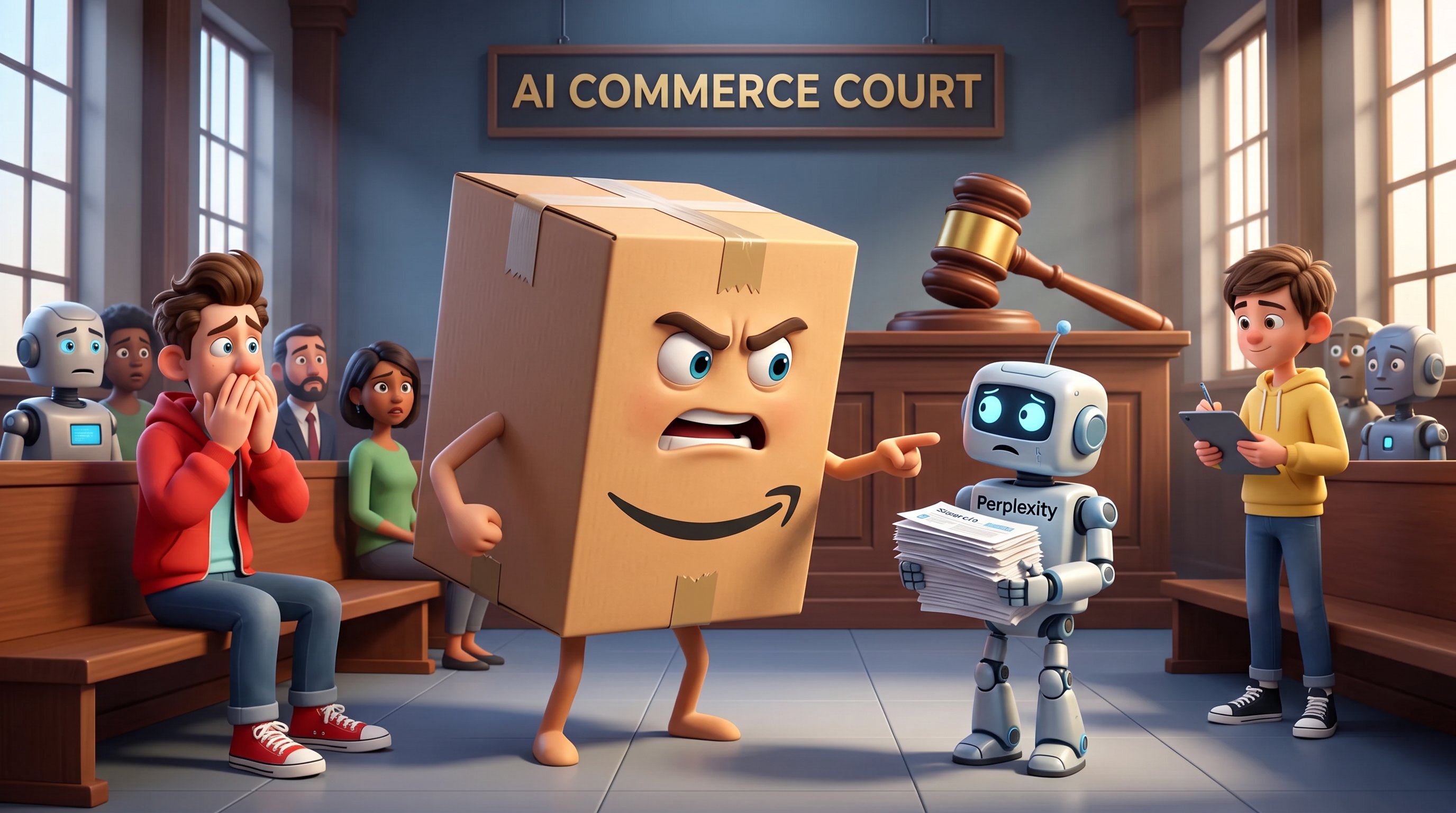

The charge:computer fraud.
The crime?Allowing users to shop on Amazon using AI.
This isn’t just a legal dispute between two tech companies. It’sthe first major legal conflict over the future of AI-driven commerce– and the outcome will affect how all businesses can reach customers in an AI-powered world.
What is the conflict about?
Perplexity AI launched its AI browserCometin July – an assistant that can browse the web, organize tabs, write emails, and shop for users. When someone asks Comet to “find and buy a new washing machine,” the AI can search Amazon, compare products, and complete the purchase – all without the user leaving Perplexity’s interface.
Amazon is not pleased. Intheir official statementand inthe lawsuit according to CNBC, Amazon accuses Perplexity of:
- Violating terms of serviceby not identifying Comet as an AI agent
- Committing computer fraudby concealing that it’s a bot acting
- Degrading customer experienceby providing impersonal recommendations without user history
- Creating security risksand privacy issues
Amazon CEO Andy Jassy said on the company’s earnings call last week that the customer experience for AI shopping agents is “not good” due to lack of personalization and inaccurate delivery estimates.
Perplexity’s defense: “Bullying is not innovation”
Perplexity responded with a blog post titled“Bullying is not innovation.”Company founder Aravind Srinivas argues that:
- AI agents areextensions of users, not independent bots
- Comet uses the user’s own credentials (stored locally, not on Perplexity’s servers)
- An AI agent should have“the same rights and responsibilities” as a human user
- Amazon just wants to protect its lucrative advertising business
Perplexity writes:“Amazon should love this. Easier shopping means more transactions and happier customers. But Amazon doesn’t care. They’re more interested in serving you ads, sponsored results, and influencing your purchasing decisions with upsells and confusing offers.”
What’s really at stake?
On the surface, this is about technical details – must an AI agent identify itself as an agent? But in reality, it’s about something much bigger:who controls the future of e-commerce?
Amazon’s perspective:
- Amazon has invested billions in building a platform with personalized recommendations, product placements, and advertising
- The company’s advertising business generates enormous revenue by selling prominent placement in search results
- If AI agents shop for customers, they skip all these “upsells” – no one sees the ads, no one buys impulse items
- Amazon already launched its own AI assistantRufusin February and is testing an agent called“Buy For Me”
Perplexity’s perspective:
- Users have the right to use whatever tools they want to browse the web
- An AI agent acting on a user’s behalf is no different from a regular web browser
- Platforms cannot discriminate against users based on what tools they use
- This is about user freedom versus platform control
Why this conflict matters for all businesses
AsTechCrunch reports: this isAmazon’s first legal offensive against an AI company, and it sets a precedent for the entire industry.
Amazon points out that other third-party agentsdo identifythemselves when acting for users – food delivery apps tell restaurants they’re ordering through an app, travel booking apps tell airlines they’re booking through an agent. Amazon argues Perplexity should do the same.
But the underlying question is more fundamental:Should platforms be able to block AI agents entirely?
If Amazon wins this legal battle, they could choose to only allow their own Rufus assistant to shop on the platform – and block all external AI agents. This would mean:
- Usersmustuse Amazon’s own AI to get AI-assisted shopping
- Competitors like ChatGPT, Perplexity, and Claude are blocked from helping users shop
- Amazon completely controls which products are shown to AI users
An ironic detail: Perplexity runs on Amazon
As several media outlets point out, there’s an ironic dimension to the conflict:Perplexity is a major customer of Amazon Web Services (AWS)and runs its infrastructure on Amazon’s cloud platform. Additionally, Amazon founder Jeff Bezos is an investor in Perplexity.
Two intertwined companies now stand against each other in a battle that could define the future of web automation.
What does this mean for your business?
Even though the battle is playing out between two American tech giants, it has direct consequences for e-commerce businesses everywhere:
- AI agents are coming – regardless of outcome
Regardless of how this legal battle ends, AI-assisted shopping will grow explosively. ChatGPT already has “Instant Checkout,” PayPal is partnering with OpenAI and Perplexity, and Google is developing its own solutions. Millions of consumers will use AI to shop.
- AI visibility becomes critical
If major platforms like Amazon can block external AI agents, it becomes even more important to be visible in the AI systems thatare allowed– or better yet, in the independent AI platforms that users trust more than platform-owned assistants.
- Authenticity and reputation win
One of Perplexity’s strongest arguments is that their AI recommendations are genuine – based on reviews, user feedback, and actual quality – not on who pays the most for advertising. If users start trusting independent AI agents more than platform-controlled search results, youractual reputationbecomes more important than ever.
- Platform independence becomes an advantage
Businesses that rely solely on Amazon, Google Shopping, or other single platforms risk becoming victims of platform wars like this one. Building visibility and credibility on theopen web– where AI agents can find you regardless of platform politics – becomes a strategic advantage.
How Kaistone helps you navigate AI commerce’s new rules
The battle between Amazon and Perplexity is just the beginning. Over the coming months and years, we’ll see many more legal, technical, and strategic conflicts as AI agents reshape e-commerce.
At Kaistone, we are leading experts inAEO (Answer Engine Optimization)and help businesses position themselves for success in this new reality – regardless of how the legal battles end.
Our services for the new era of AI commerce:
- Multi-platform AEO strategy:We optimize your visibility not just for one AI platform, but for ChatGPT, Perplexity, Claude, Gemini, and emerging systems – so you’re not dependent on a single player
- Reputation and credibility strategy:We help you build the authentic digital reputation that AI systems value – through reviews, mentions, user engagement, and content that AI models can trust
- Platform-independent visibility:We ensure your product information and expertise is accessible on the open web in ways that AI agents can find and use – regardless of which platforms block which agents
- Competitive intelligence:We monitor developments in AI commerce, legal battles, and new platforms, and continuously adapt your strategy
- AEO audit and implementation:We map your current position in AI search systems and implement concrete improvements
We also holdregular seminarswhere we share the latest insights on how AI agents, platform wars, and new technologies are changing e-commerce, and what businesses need to do to stay ahead.
Amazon and Perplexity are fighting over the future of e-commerce. Regardless of who wins, your business needs a strategy for AI-driven visibility. No one understands AEO like we do at Kaistone. Contact us today to secure your position in the new AI-driven market – before your competitors do.
Read more about the conflict:
- CNBC: Perplexity AI accuses Amazon of bullying
- TechCrunch: Amazon sends legal threats to Perplexity
- Amazon: Official statement about Perplexity